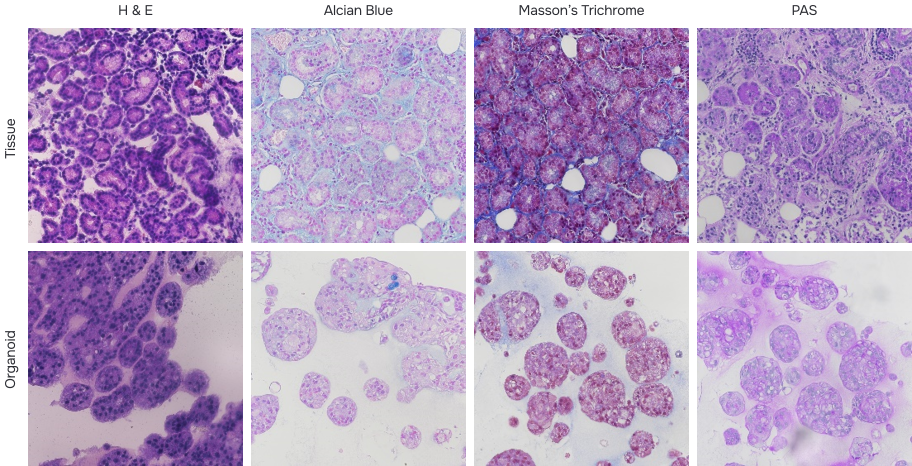
Comprehensive Staining Reveals Key Features in Lacrimal Gland Organoids
In the lacrimal gland organoid, the structure of acinar cells and their secretion of acidic mucins were observed by H&E, Alcian blue. Additionally, through PAS staining, secretions such as glycogen and glycoproteins were observed in the organoid. Masson’s Trichrome staining demonstrated that keratin is a major ECM component in the organoid.
Histology data
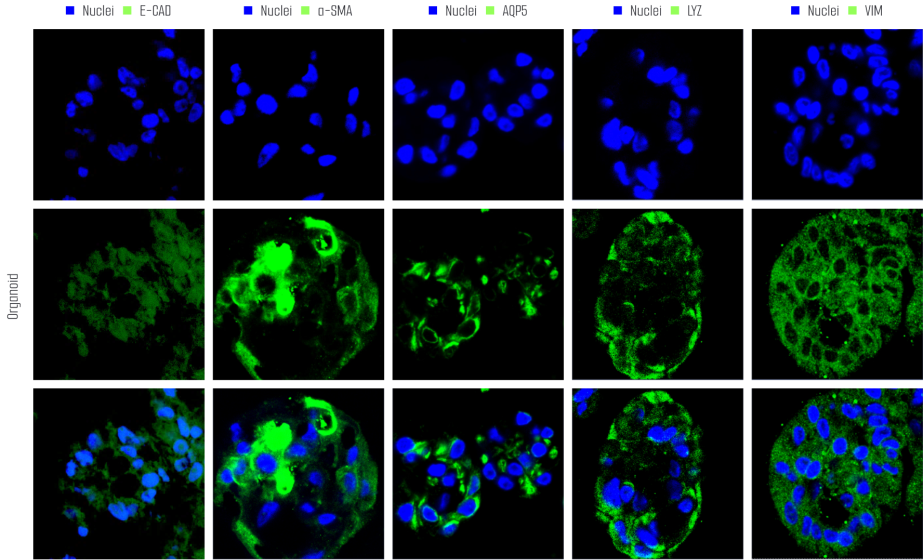
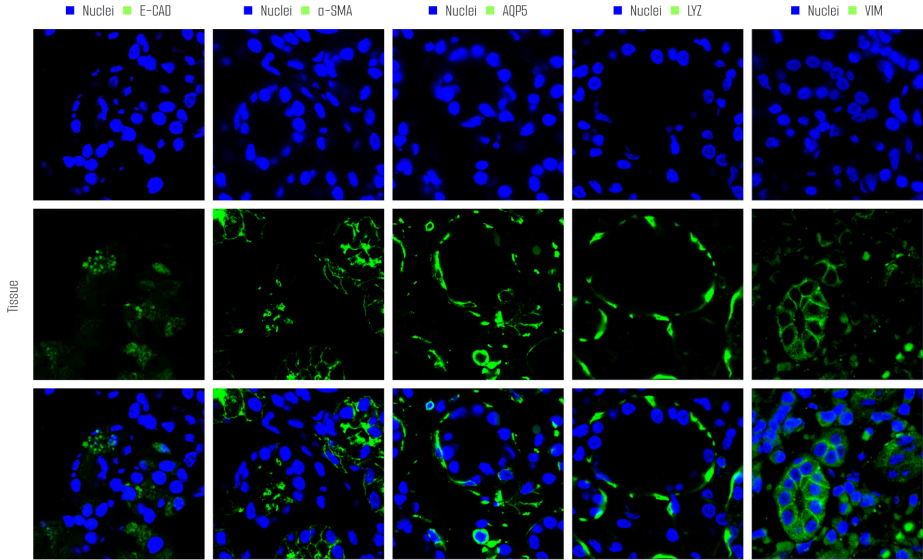
Acinar Cell-Like Expression Patterns of Key Markers in Organoids
The expression patterns of VIM, AQP5, and LYZ within the organoid closely resemble those of the tissue’s acinar cells. Furthermore, the expression patterns of E-CAD and α-SMA in the organoid are similar to those in the tissue, though at lower levels. These markers are not expressed in ductal cells but are expressed in acinar cells, confirming that the formed organoid closely resembles acinar cells.
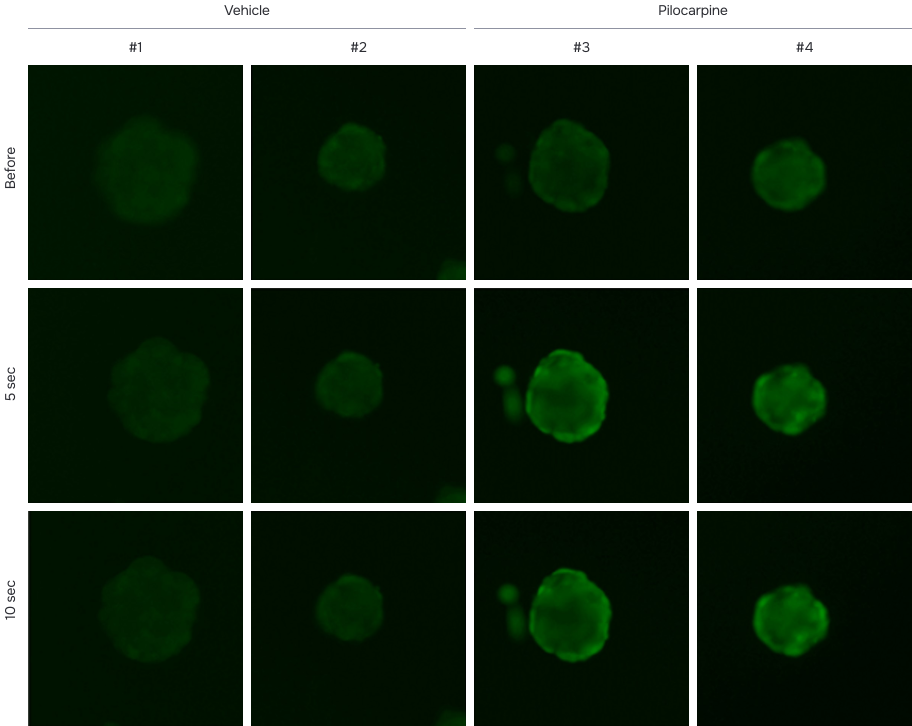
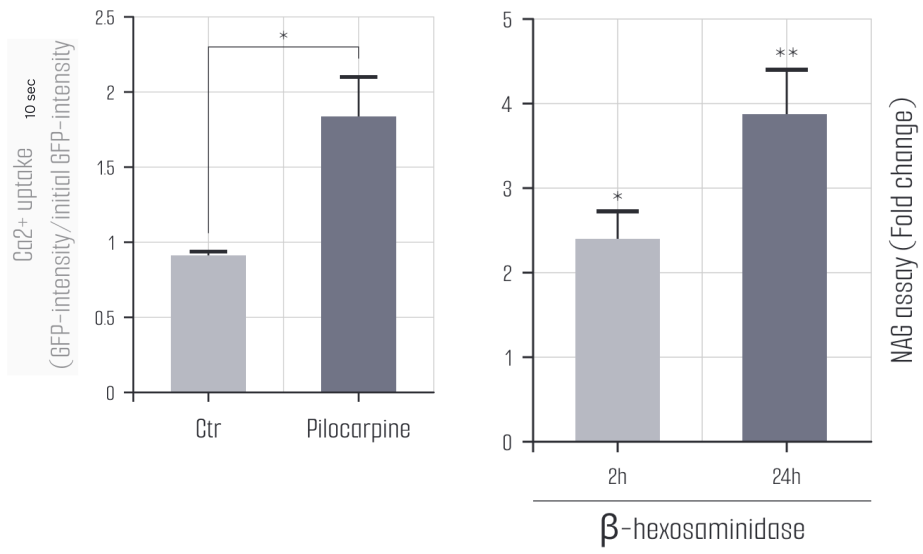
Assessment of Secretory Function in Lacrimal Gland Organoids with Pilocarpine Treatment
- To assess the secretory function, lacrimal gland organoids were treated with pilocarpine.
- The intracellular concentration of Ca ions increased, confirming the elevation of the lysosomal protein β-hexosaminidase, a component of tears.
Advance Drug Discovery with Smarter, Ethical Models.
Interested in bringing human-relevant lung models into your research?
Contact Lambda Biologics to discuss your project with our team.
Frequently Asked Questions
What makes Lambda Biologics’ lacrimal gland organoids different from conventional cell models?
Our 3D organoids recapitulate native lacrimal gland architecture, express key tear-gland markers, and respond functionally to pilocarpine. This provides a more predictive platform than 2D cultures for studying secretion, disease mechanisms, and drug effects.
What research applications are best suited for these organoids?
They are ideal for dry-eye disease modeling, drug efficacy and toxicity testing, tear-secretion studies, and exploring regenerative or cell-therapy approaches for lacrimal gland repair.
What validation data is available for your organoid models?
We provide detailed technical data sheets covering differentiation methods, marker expression, and functional validation, so you can trust the reliability and reproducibility of your results.
Can the organoids be customized or integrated into existing workflows?
Yes. Lambda Biologics offers flexible formats – frozen organoids, live cultures, or assay-ready plates – and can collaborate on protocol adaptation to fit your specific experimental design.
How do I get started with ordering or discussing a project?
Simply contact Lambda Biologics team. Our scientists will review your project needs and provide the right options whether it’s technical guidance, a quote, or custom organoid development.