High-Elasticity Artificial Skin for Advanced Skin Model Applications
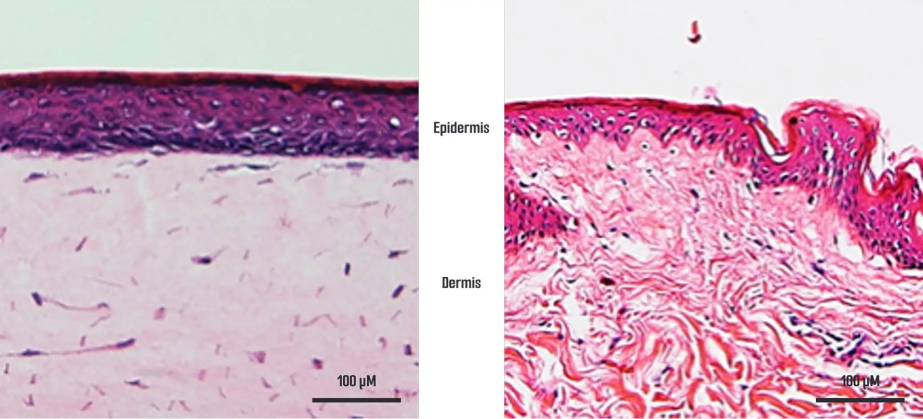
Engineered using state-of-the-art 3D bioprinting technology and dECM (decellularized extracellular matrix) bio-ink, this artificial skin model precisely replicates the biomechanical properties and elasticity of human skin. By enabling quantitative assessment of skin elasticity dynamics, this innovation establishes a new scientific standard for the evaluation of cosmetic formulations and dermatological therapeutics.
Assay Process
High-Elasticity Artificial Skin for Advanced Skin Model Applications
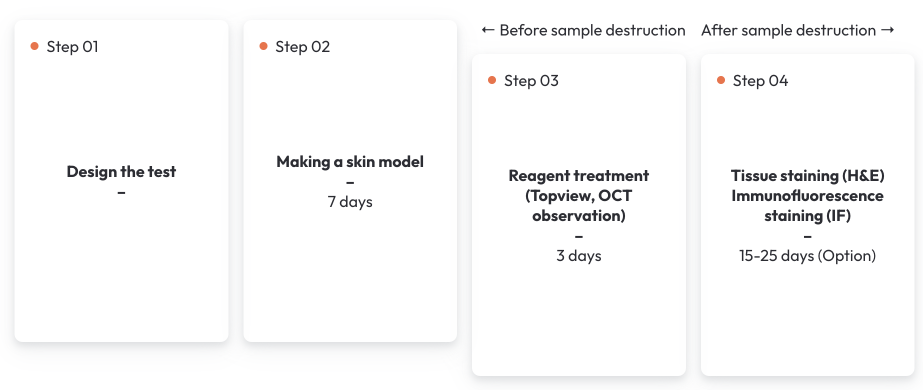
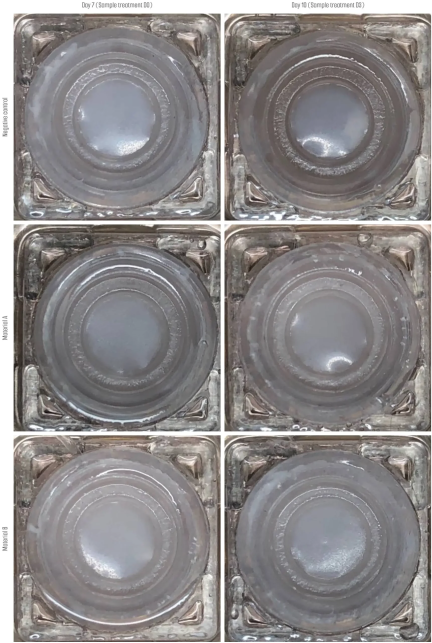
Assess the approximate external appearance condition (visual reaction according to the substance)
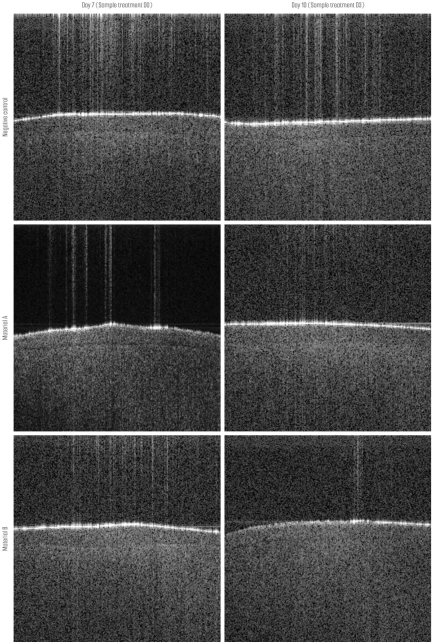
Confirming the approximate reaction of the substance on OCT (Optical Coherence Tomography) (including epidermal formation and tissue thickness)
OCT observation
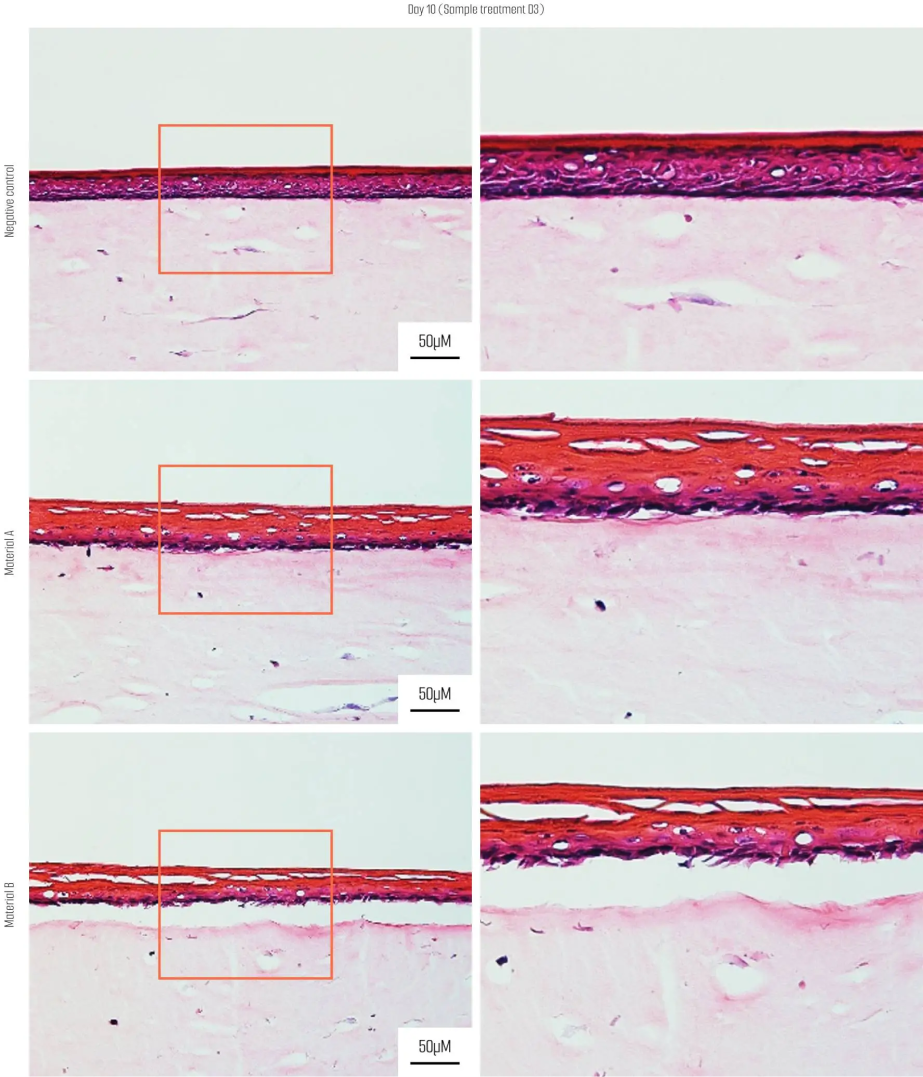
Advance Your Skin Research with Artificial Skin Models
Leverage our 3D-printed full-thickness artificial skin platform to generate physiologically relevant data for drug and cosmetic testing. Contact Lambda Biologics to discuss your study design and testing needs.
Frequently Asked Questions
What is artificial skin and how is it used in drug testing?
Artificial skin is a 3D in vitro skin model designed to replicate the structure and biological functions of human skin. In drug testing, artificial skin is used to evaluate drug efficacy, safety, penetration, and biological responses without relying on animal models. By mimicking human epidermal and dermal architecture, artificial skin provides more physiologically relevant data compared to conventional 2D cell cultures.
How does a full-thickness artificial skin model differ from epidermis-only skin models?
A full-thickness artificial skin model incorporates both the epidermis and dermis, whereas epidermis-only models represent only the outer skin layer. The inclusion of the dermal compartment enables critical epidermal–dermal interactions, extracellular matrix (ECM) signaling, and fibroblast-mediated responses. As a result, full-thickness artificial skin models offer improved predictive accuracy for drug efficacy and skin biology compared to epidermis-only systems.
What are the advantages of 3D-printed artificial skin models?
3D-printed artificial skin models provide precise control over tissue architecture, layer thickness, and cell distribution. This technology enhances reproducibility and scalability while enabling the creation of complex, physiologically relevant skin structures. For in vitro testing, 3D printing allows artificial skin models to closely resemble native human skin, improving consistency across experiments and supporting high-quality translational research.
Which biological markers and proteins can be analyzed using artificial skin models?
Artificial skin models support the analysis of a wide range of biological markers, including epidermal differentiation markers, dermal fibroblast-associated proteins, extracellular matrix components, and proteins localized at the epidermal–dermal interface. This comprehensive protein profiling enables deeper insight into skin responses, tissue remodeling, and drug-induced biological effects that are not observable in traditional epidermal models.
What applications does Lambda Biologics’ artificial skin platform support?
Lambda Biologics’ artificial skin platform supports applications in drug efficacy testing, skin toxicity and irritation assessment, permeability studies, and cosmetic evaluation. The platform is designed for animal-free testing and provides a physiologically relevant in vitro system for pharmaceutical, biotechnology, and cosmetic research requiring advanced human skin models.