General Information

Bacteria Research

Price:
Accurate quantification and characterization of bacteria are essential in microbiology, biotechnology, and pharmaceutical research. Traditional bacterial counting methods often rely on staining, culturing, or agar plate assays, which are time-consuming and may introduce variability. Using Holotomography (HT), Lambda Biologics enables precise, label-free counting of bacterial spores and cells, eliminating the need for dyes or staining steps during sample preparation.
Organism
Product Type

Tissue

Disease

Applications

  • Holotomography: Cell biology

Bacteria Research

The Bacterial Cell Counter provides accurate CFU values while reducing additional experimental steps.

Preliminary studies with B. subtilis spores showed results consistent with traditional methods, but further validation is needed to improve measurement precision. This system can also be used for various other applications, including vegetative cell counting, particle counting, and fungal spore counting.
Label-free Spore Counting
HT technology allows for precise spore counting of bacteria without the need for labeling, reducing additional steps such as staining during sample preparation.
High-resolution 3D Imaging
HT provides high-resolution 3D imaging at 110 nm, allowing for the detailed observation of microscopic structures like bacteria, with fast acquisition speeds that minimize blurring due to Brownian motion.
Quantitative Information
HT offers quantitative data on spore volume, surface area, dry mass, and sphericity, enabling accurate CFU calculations.
Automated CFU Calculation
The Bacterial Cell Counter automatically analyzes multiple holotomograms to calculate CFU values efficiently, making it faster and more effective than traditional agar plate methods.
Versatile Applications
This system can be used not only for spore counting but also for counting vegetative cells, microbeads, and fungal spores, demonstrating its broad application potential.

Advantage

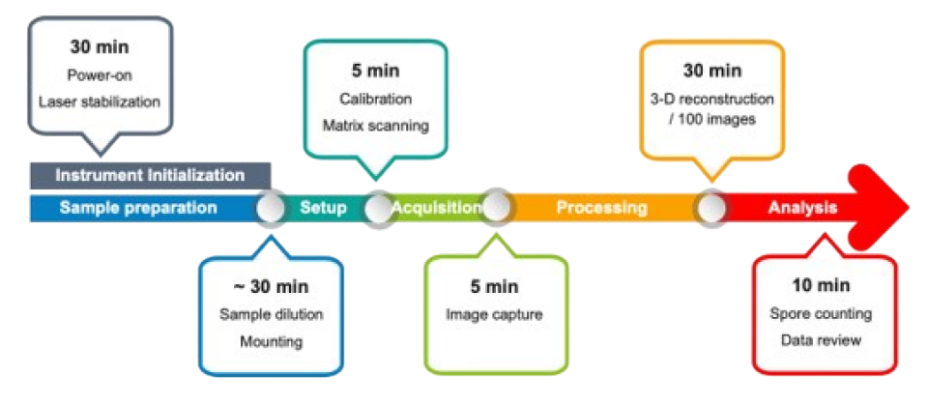
The primary advantage of the Bacterial Cell Counter is its ability to rapidly and accurately assess infection status in real-time. Using holotomography, the system automatically counts colony-forming units (CFU) in bacterial culture samples. By analyzing the 3D refractive index maps of the samples, the counter identifies spores based on their unique refractive indices and applies morphological parameters, such as size, to deliver precise results within minutes. This enables laboratories to monitor infection status live and respond quickly to any changes.

Trusted by Leading Innovators

Customer insight

Functional Testing of Anaerobic Microbes Using Organoids

Chong Kun Dang - better life through better medicine

“We have been developing products utilizing various bacterial strains and have explored multiple methods to evaluate the efficacy of our developed strains. However, due to the nature of obligate anaerobic bacteria, there were significant limitations in applying conventional in vitro efficacy evaluation methods. To overcome these challenges, we explored different testing approaches and discovered the ODISEI platform...

Customer insight

Advancing K-Beauty with Skin Organoids

Professor Lee Chang-seok Eulji University

“Advancing K-Beauty with Skin Organoids: A Next-Generation Platform for Non-Animal Testing and High-Precision Cosmetic Innovation With the global rise of K-beauty, the cosmetics industry continues to grow steadily. Since the ban on animal testing for cosmetics in Korea in 2017, various alternative testing methods have been adopted. However, many of these approaches have limitations in replicating the complexity...

Customer insight

HT-X1: A Label-Free Imaging Breakthrough for Organoid-Based Disease Modeling and Drug Screening

Tomocube (Spatial)

“Traditional microscopy methods often require fluorescent labeling to analyze cellular structures, which can be time-consuming and invasive. In contrast, our HT-X1 system allows for high-resolution visualization of cellular morphology without the need for any labeling, offering a clear advantage in live-cell imaging. To validate this capability, we conducted an organoid-based analysis using intestinal organoids...

Customer insight

Advancing Clinical Pathology with Spatial Protein Analysis

Seoul National University College of Medicine

“Traditional protein analysis has primarily focused on quantifying expression levels within tissue samples. However, recent advances in spatial analysis techniques have shifted attention toward evaluating not only expression levels, but also the spatial distribution, density, and proximity between proteins...

Customer insight

Revealing Immune-Boosting Potential with ODISEI-Gut

K Research Institute

“Among the many fermented foods we consume, kimchi is particularly known for containing a diverse range of lactic acid bacteria, which are believed to influence the activation of immune cells in the body. In our research institute, we successfully isolated a bacterial strain that appears to enhance immune cell function. To evaluate its effect in the intestinal environment, we utilized the ODISEI-Gut platform...

Customer insight

Multiplex Marker Analysis Enhances Research Efficiency with 31-Marker Detection on a Single Slide

Bundang Jesaeng General Hospital

“We conducted a study focused on identifying disease-related markers using patient-derived tissue samples. However, traditional methods limited our ability to analyze multiple candidate markers simultaneously, and the limited availability of clinical samples posed a consistent challenge...

Customer insight

Redefining Gastric Cancer Research with Patient-Derived Organoids

SOON CHUN HYANG UNIVERSITY HOSPITAL

“Gastric cancer is one of the leading causes of cancer-related mortality worldwide. It is a malignant solid tumor characterized by poor prognosis due to difficulties in early diagnosis and its rapid progression. Unlike many other solid tumors that primarily metastasize via lymphatic or hematogenous routes, gastric cancer most commonly spreads through the peritoneum....

Customer insight

Breast Cancer PDOs for TNBC Drug Development

GANGNAM SEVERANCE HOSPITAL

“Breast cancer is one of the most commonly diagnosed cancers among women worldwide. It is a complex and heterogeneous disease, with its progression and treatment response varying significantly depending on factors such as hormone receptor status, HER2 expression, and genetic background...

Customer insight

Transforming Gastric Cancer Treatment: Lambda Biologics’ PDOs Platform

SOON CHUN HYANG UNIVERSITY HOSPITAL

“Gastric cancer is one of the leading causes of cancer-related mortality worldwide. It is a malignant solid tumor characterized by poor prognosis due to difficulties in early diagnosis and its rapid progression. Unlike many other solid tumors that primarily metastasize via lymphatic or hematogenous routes, gastric cancer most commonly spreads through the peritoneum...

Customer insight

A Novel Drug Proven to Penetrate the Tumor Microenvironment

Autotelic bio

“Our newly developed drug differs from previously known therapeutics in that it directly penetrates various tumor tissues to exert its efficacy. Therefore, it was essential to analyze the drug’s penetration within the tumor microenvironment. To evaluate this, we conducted permeability testing in a co-culture system of tumor organoids and cancer-associated fibroblasts (CAF)...