“90% of drugs that show promise in animal tests fail in human clinical trials.”
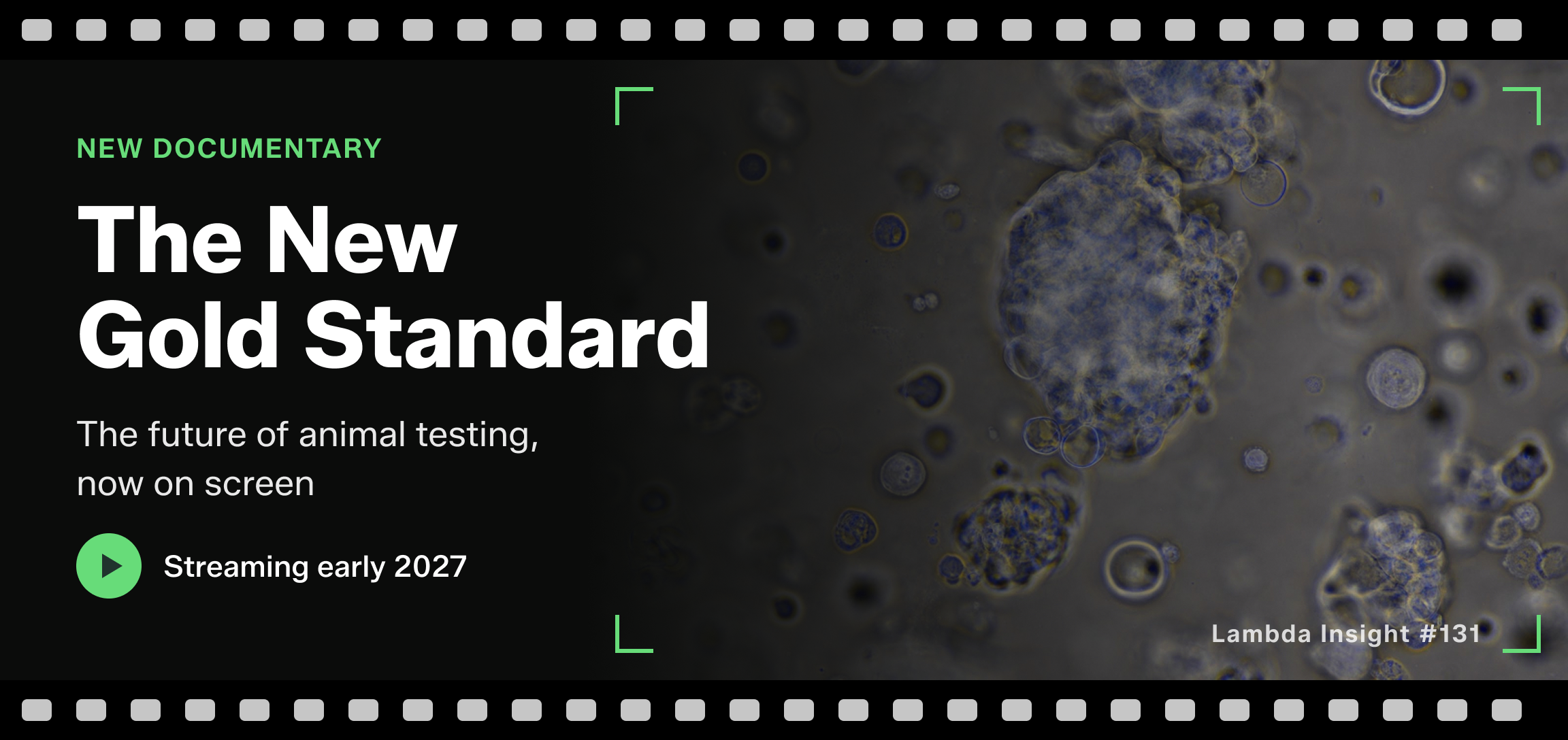
This opening line from the trailer for The New Gold Standard documentary raises a question that continues to challenge drug development: how can researchers better predict whether a treatment will work safely in people?
The FDA has highlighted a similar concern, reporting that more than 90% of drugs that clear animal studies do not receive approval, often because of safety or efficacy issues identified in human trials. This gap has strengthened interest in research methods that more closely reflect human biology. (1)
A Closer Look at Human-Based Research
Narrated and executive produced by Maggie Q, The New Gold Standard explores the development of human-based research technologies through interviews with scientists, policymakers, pharmaceutical leaders, and individuals whose lives have been affected by animal experimentation and advances in research. (2)
The documentary visits institutions including Harvard and Stanford, introducing audiences to researchers developing new approaches to studying disease and evaluating medicines. It also examines the ethical questions surrounding laboratory animal use through personal accounts and visits to animal sanctuaries.
By bringing these perspectives together, the film opens a discussion usually held within laboratories and regulatory meetings to a broader audience.
The New Gold Standard will be available for streaming in early 2027. (thenewgoldstandard.film)
 Watch the official trailer
Scientific Progress Meets Regulatory Change
The film arrives during a significant period for alternatives to animal testing.
In April 2025, the FDA announced a roadmap to reduce animal testing in drug development and encouraged the submission of data from New Approach Methodologies (NAMs). These approaches include human organoids, organ-on-a-chip systems, and computational models. (3)
In September 2026, the agency announced a regulatory update (4) clarifying that appropriate non-animal methods can support nonclinical safety evaluation. These developments expand the opportunities for human-relevant approaches, while maintaining existing standards for the evidence needed to support drug development.
Read our summary of how the FDA, NIH, and EMA moved on non-animal testing in September 2026.
The Role of Organoid Technology
Human organoids are three-dimensional cultures that reproduce selected structural and functional features of human tissues. They allow researchers to investigate disease mechanisms, drug responses, and potential toxicity in a human cellular context. Patient-derived models can also support studies of differences in treatment response. Their wider adoption depends on careful model selection, reproducible protocols, and validation for each intended application. These practical considerations are essential to turning scientific potential into reliable research tools.
At Lambda Biologics, we support researchers through organoid models, specialized culture solutions, and research services for disease modeling, drug efficacy, and toxicity studies.
Explore Lambda Biologics’ organoid solutions or contact bd@lambdabiologics.com to discuss your research needs. You can also reach our team through the contact page.