Generation Process
Tissue-Derived Lung Organoids
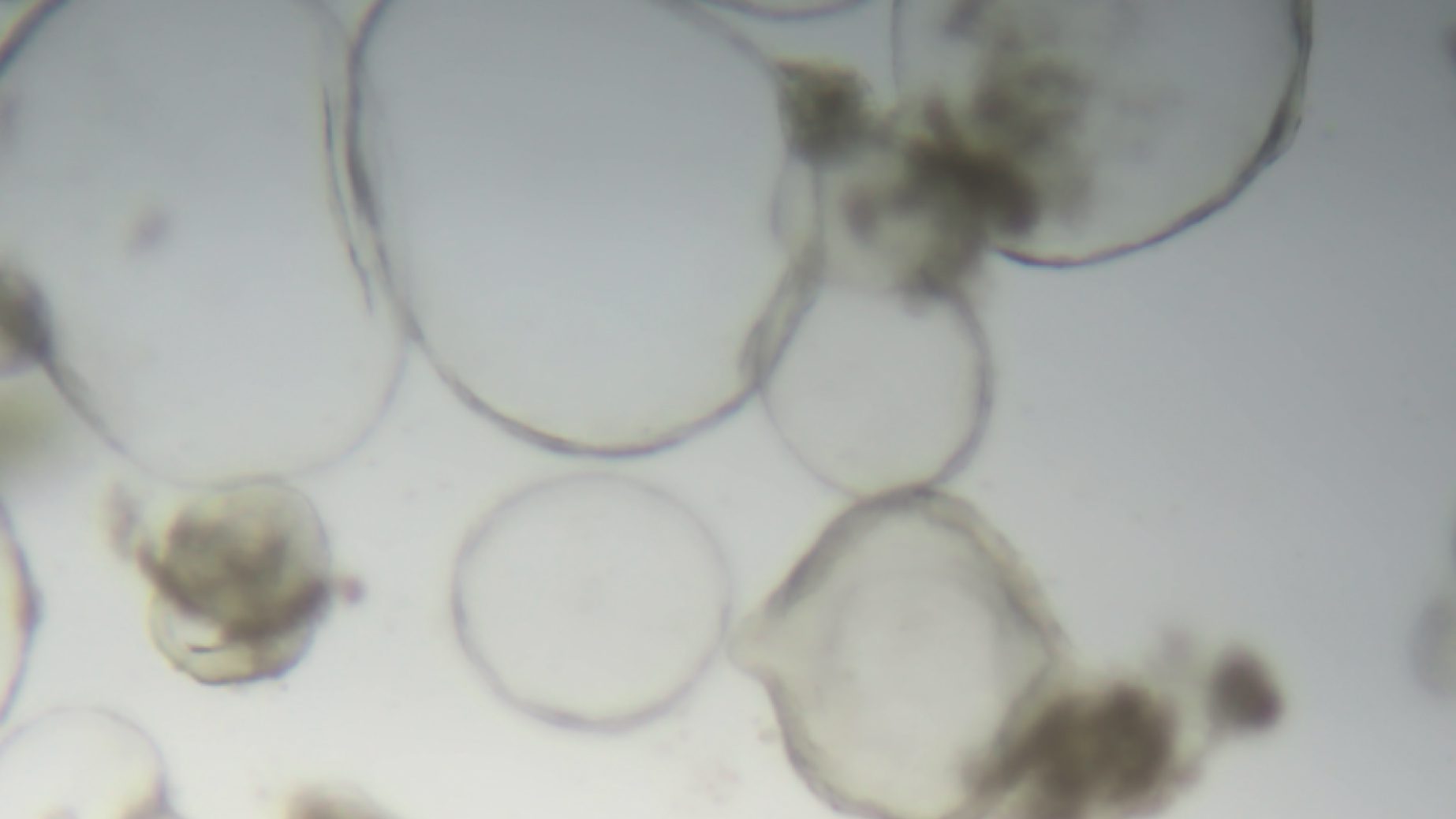
These organoids are generated directly from patient lung tissue or biopsy samples. The cells are cultured under optimized conditions that preserve their native genetic profile and cell-to-cell interactions. As a result, tissue-derived organoids faithfully reproduce the cellular composition and microenvironment of the original lung tissue. Their patient-specific nature makes them particularly valuable for personalized medicine, disease modeling, and translational research.
iPSC-Derived Lung Organoids
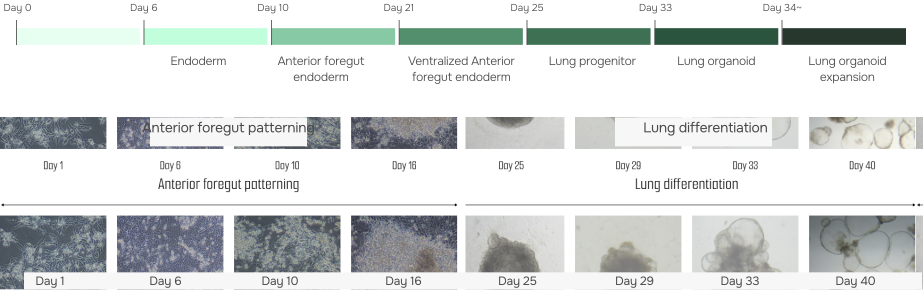
Using induced pluripotent stem cells (iPSCs), we recreate the early developmental processes of the lung. iPSCs are guided through stepwise differentiation into mature lung cell types and structures, producing scalable and customizable organoids. These models reflect a wide range of genetic backgrounds and environmental conditions, making them powerful tools for long-term studies, high-throughput drug screening, and regenerative medicine applications.
Cellular and Structural Similarity
Structural characteristics of lung organoids
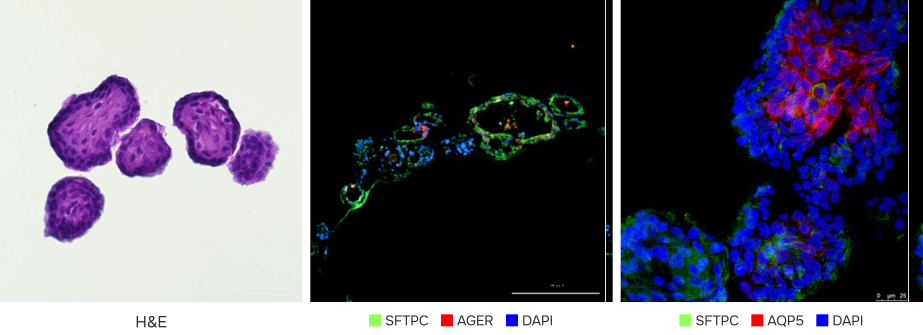
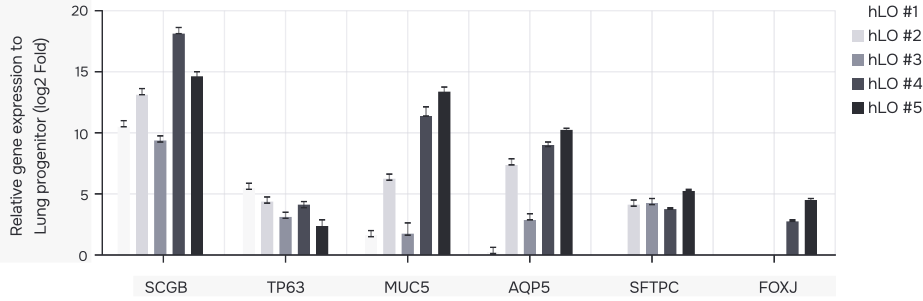
Lambda Biologics lung organoids faithfully reproduce the architecture of human lung tissue, including key structures such as alveoli. They contain diverse cell types – type I and II alveolar epithelial cells, ciliated cells, and secretory cells – capturing the complexity and function of real lung tissue in a reproducible model.
Expression markers
- SFTPC
Type II pneumocytes - AQP5
Bronchial epithelial cells - AGER
Epithelial cells - TP63
Lung epithelial cells - SCGB
Mucous cells, Respiratory tissue cells - MUC5
Mucous cells - FOXJ
Mucous cells
Proof of Concept Studies
Influenza Virus Modeling
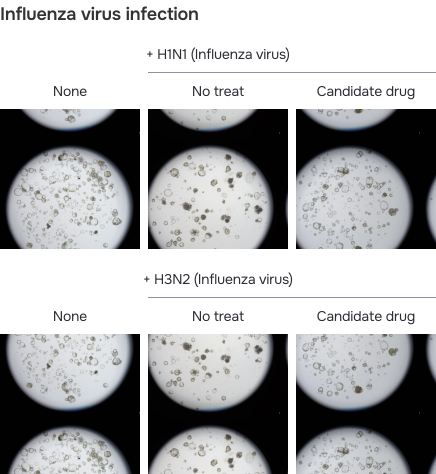
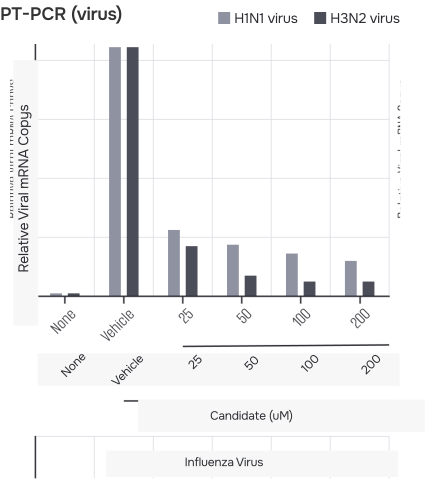
After infecting PSC-derived lung organoids with H1N1 and H3N2 influenza viruses and treating them with candidate drugs at different concentrations (25, 50, 100, 200 µM), RT-PCR analysis revealed a dose-dependent reduction in viral RNA copy numbers. Notably, a significant decrease in viral RNA copy numbers was observed in the candidate drug-treated groups for both H1N1 and H3N2 influenza, suggesting that these candidate drugs may effectively inhibit influenza virus replication.
Pulmonary Fibrosis Modeling
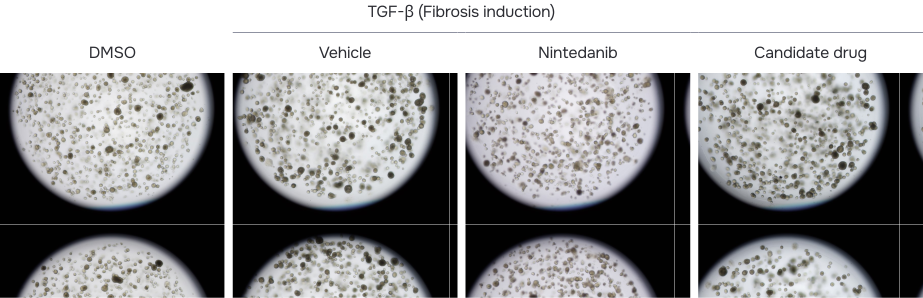
In the tissue-derived lung organoids with fibrosis induced by TGF-β, immunohistochemical analysis revealed that Nintedanib treatment led to a reduction in the expression of fibrosis markers, A-SMA and Vimentin, confirming its antifibrotic effect. Similar trends were observed in some candidate drug groups, with certain candidates showing a significant decrease in fibrosis marker expression, suggesting potential antifibrotic effects. These findings indicate that Nintedanib and specific candidate drugs may have potential as therapeutic agents for pulmonary fibrosis.
Advance Drug Discovery with Smarter, Ethical Models.
Interested in bringing human-relevant lung models into your research?
Contact Lambda Biologics to discuss your project with our team.
Contact Lambda Biologics to discuss your project with our team.
Frequently Asked Questions
What are lung organoids?
Lung organoids are 3D, lab-grown models derived from human stem cells or tissues. They mimic the architecture, cell diversity, and functions of human lung tissue, making them powerful tools for studying development, disease, infection, and drug responses in a human-relevant system.
What makes Lambda Biologics’ lung organoids different from standard 2D cultures or animal models?
Our organoids replicate the 3D structure, cell diversity, and function of human lung tissue. This gives more predictive and human-relevant data compared to 2D monolayers or animal studies, reducing the gap between discovery and clinical translation.
What validation data is available for your organoid models?
We provide detailed technical data sheets covering differentiation methods, marker expression, and functional validation, so you can trust the reliability and reproducibility of your results.
Can lung organoids be customized for my specific research needs?
Yes. We provide both tissue-derived and iPSC-derived organoids. These can be tailored to patient backgrounds, disease models, or experimental conditions depending on your research goals.
How do I get started with ordering or discussing a project?
Simply contact Lambda Biologics team. Our scientists will review your project needs and provide the right options whether it’s technical guidance, a quote, or custom organoid development.