



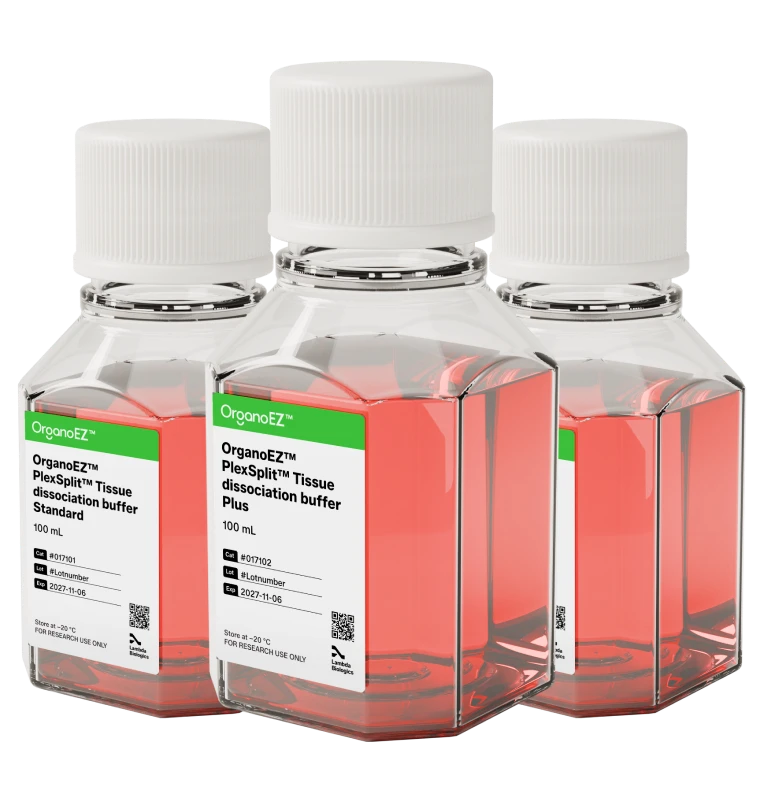
READY-TO-USE DISSOCIATION BUFFER
OrganoEZ™ PlexSplit™ Tissue dissociation buffer (Standard / Plus / Gentle)
Premixed, ready-to-use enzymatic dissociation buffers for patient cancer surgical and biopsy specimens, in Standard, Plus and Gentle types.
Catalog #
017101 / 017102 / 017103
Size
100 mL
Storage
−20 °C
Shelf life
6 months from MFG date
What's included
1 × OrganoEZ™ PlexSplit™ Tissue dissociation buffer (Standard, Plus or Gentle), 100 mL
Key Features

Ready to use
Premixed enzymatic solution requiring no enzyme reconstitution. Suitable for most tissue types without additional supplementation.

High efficiency
Maximizes tissue dissociation while preserving cell viability for organoid establishment.

Integrated
Compatible with OrganoEZ™ PlexFlow™ Wash buffer, OrganoEZ™ GelMatrix™ ECM and OrganoEZ™ OncoPlex™ medium.
Product Overview
Ready-to-use dissociation buffers for patient-derived cancer organoid workflows, in three tissue-matched types
OrganoEZ™ PlexSplit™ Tissue dissociation buffer is a premixed, ready-to-use enzymatic solution designed to dissociate surgically resected patient cancer tissues and biopsy specimens into viable single cells and small cell clusters.
It supports efficient tissue dissociation and high viable-cell recovery without enzyme reconstitution or extensive protocol optimization. Use it after washing with OrganoEZ™ PlexFlow™ Wash buffer; the isolated cells can be embedded in OrganoEZ™ GelMatrix™ ECM and cultured in OncoPlex™ Medium to establish patient-derived cancer organoids.
Subtype
Enzymatic Dissociation Buffer
Cell / tissue type
Patient cancer tissue, Biopsy
Species
Human
Application
Tissue dissociation, single-cell isolation
Area of interest
Patient-derived cancer organoid research
Sterility & QC
Sterile
Formulation category
Premixed enzymatic solution
Choose your buffer type
Three tissue-matched types. Each has been found to give better cell preparation from the cancer types listed.
Standard
Cat. #017101100 mL · −20 °C
RECOMMENDED CANCER TYPES
● Colorectal cancer
● Lung cancer
● Gastric cancer
● Renal cell carcinoma
● Ovarian cancer
Plus
Cat. #017102100 mL · −20 °C
RECOMMENDED CANCER TYPES
● Breast cancer
● Pancreatic cancer
● Cholangiocarcinoma
● Cervical cancer
Gentle
Cat. #017103100 mL · −20 °C
RECOMMENDED CANCER TYPES
● Endometrial cancer
From washed tissue to viable single cells
A high-yield enzymatic extraction procedure
01
Wash & mince
Wash specimens with OrganoEZ™ PlexFlow™ Wash buffer and mince surgical tissue into ~2 mm pieces.
02

Digest
Add 5 mL buffer per 0.1 g tissue; incubate at 37 °C, 160 rpm for 30–60 min.
03
Stop & filter
Add an equal volume of OrganoEZ™ Advanced DMEM/F-12, then pass through a 100 µm strainer.
04

Collect cells
Centrifuge at 400 × g, 10 °C for 3 min (optional RBC lysis). Seed ~1 × 10⁵ viable cells per well in GelMatrix™ ECM (1:1).
Data Figures
Organoid Establishment from Patient Tissue
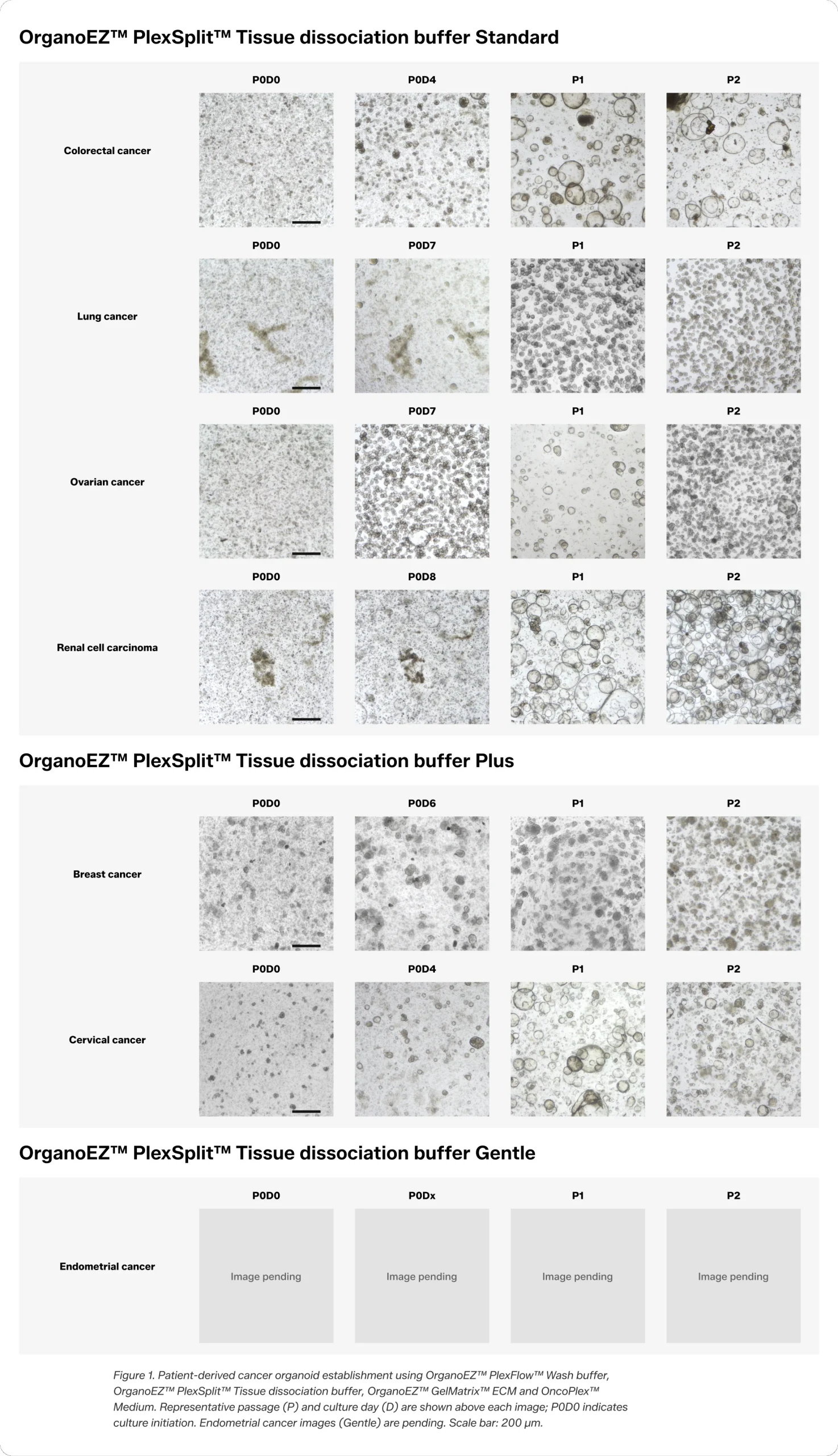
• Processed specimens yield a high proportion of viable single cells and small cell clusters, with minimal residual undigested tissue.
• Cells seeded in OrganoEZ™ GelMatrix™ ECM domes and cultured in OrganoEZ™ OncoPlex™ medium establish organoids.
• Representative results are shown for each buffer type (Standard, Plus, Gentle) across multiple cancer types.
Organoid establishment by buffer type
Protocols and Documentation
Product information, safety and quality documentation
Document
Reference
Description
Product Information Sheet (PIS)
PIS · 017101–017103
Product details, preparation and directions for use
Safety Data Sheet (SDS)
SDS · 017101–017103
Hazard identification, safe handling and disposal
Certificate of Analysis (CoA)
Per lot
Quality control results for the supplied lot
Brochure
2026 edition
Overview of the OrganoEZ™ product range
Applications
A connected workflow for translational cancer organoid research
Frequently Asked Questions
How to thaw and prepare the dissociation buffer?
Thaw overnight at 2–8 °C. Mix gently; avoid vigorous shaking and excessive bubble formation.
Which buffer type should I use?
Standard for colorectal, lung, gastric and ovarian cancer and renal cell carcinoma; Plus for breast, pancreatic and cervical cancer and cholangiocarcinoma; Gentle for endometrial cancer.
Low viable cell count or cell clumping observed?
Reduce incubation time and stop as soon as enough single cells or small clusters are seen; add the equal-volume basal medium promptly and handle gently.
Tissue fragments remain after incubation?
Extend incubation up to the 60-minute maximum, mince to ~2 mm and pipette more often. For colorectal and gastric tissue, add hyaluronidase (20 µg/mL).
Related products
Recommended products across the OrganoEZ™ workflow
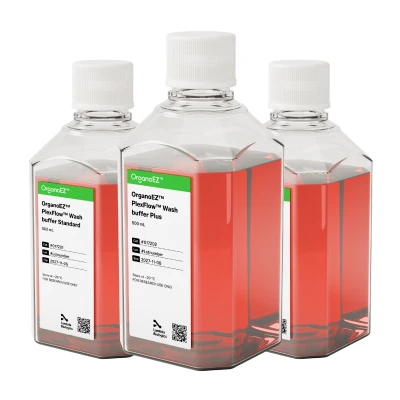
PlexFlow™ Wash buffer
Standard / Plus / Gentle buffers for washing tissue and biopsies.
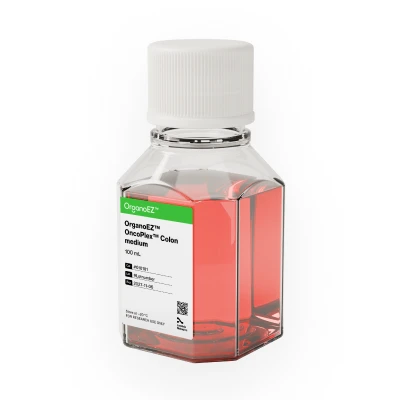
OncoPlex™ medium
Complete media for patient-derived cancer organoids.
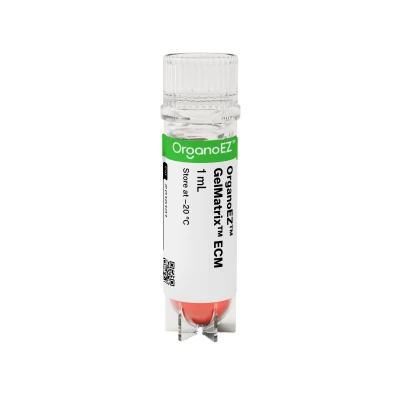
GelMatrix™ ECM
EHS-derived extracellular matrix for 3D organoid embedding.
Need documentation or a quote?
Product information sheets, SDS and lot-specific CoAs are available for every OrganoEZ™ product.